


(The Center Square) – Illinois has taken the No. 10 spot on Oxfam’s Best and Worst States to Work in America 2022. But some say it doesn’t paint a full picture.
The index of all data is based on laws and policies in effect as of July 1, 2022, across all 50 states, Puerto Rico and the District of Columbia. The index consists of three dimensions: wage policies, which comprise 40% of the overall score; worker protection rights, which comprise 35% of the overall score; and rights to organize, which comprise 25% of the overall score. Illinois received index scores of 67.77 overall, 63.17 for wages, 53.57 for worker protection, and 95.00 for the right to organize.
“This survey reads like a top 10 list of why employers are leaving the state of Illinois,” National Federation of Independent Business Illinois state director Chris Davis told The Center Square in response to the state’s ranking.
Recently, major employers have announced they are relocating corporate level jobs to other states. Among those are Tyson, Boeing, Caterpillar and Citadel.
Davis says the pandemic is definitely part of the reason why small business employers and workers are choosing to leave the state, but data has shown it happened long before COVID-19 surfaced.
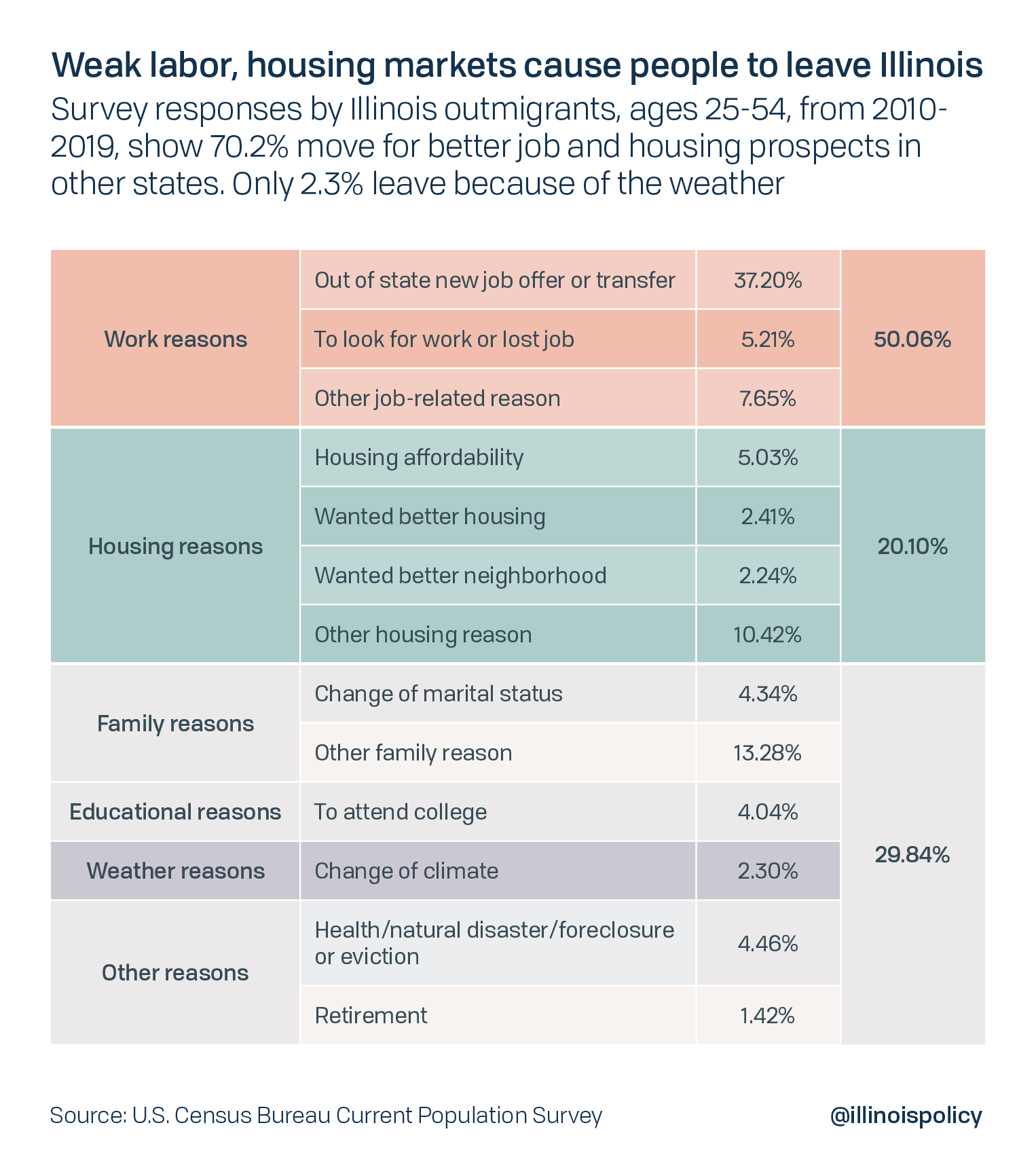
In fact, according to Illinois Policy, a survey was conducted on participants who left the state between the ages of 25 and 54 from 2010-2019, with 70.2% responding they moved due to better job or housing opportunities with only 2.3% fleeing the state due to the weather.
“This is a compilation of employer mandates, bureaucratic red tape and other struggles that small businesses face in employing people across Illinois,” Davis said.
The wage index examined how state’s minimum wages compared to the cost of living for a family of four. In January 2022, the minimum wage in Illinois went up to the $12 an hour. The rate will continue to increase annually until it caps at $15 per hour on Jan. 1, 2025. This is above the federal threshold of $7.25 an hour.
The worker protection index takes into consideration workers’ quality of life, especially as it applies to women and parents through paid sick and/or family leave, protections for women who are pregnant or breastfeeding, and limitations in sudden changes in the working schedule.
The right-to-organize dimension evaluates whether workers have the right to organize and create a trade union. Many states like Illinois have positive workers’ rights to organize so they can collectively bargain and negotiate wages. Collective bargaining results in stronger protections from employer retaliation and a door that opens to higher wages.
“Illinois has a strong history of strong union rights and strong union influence in its policy making,” Davis said.