


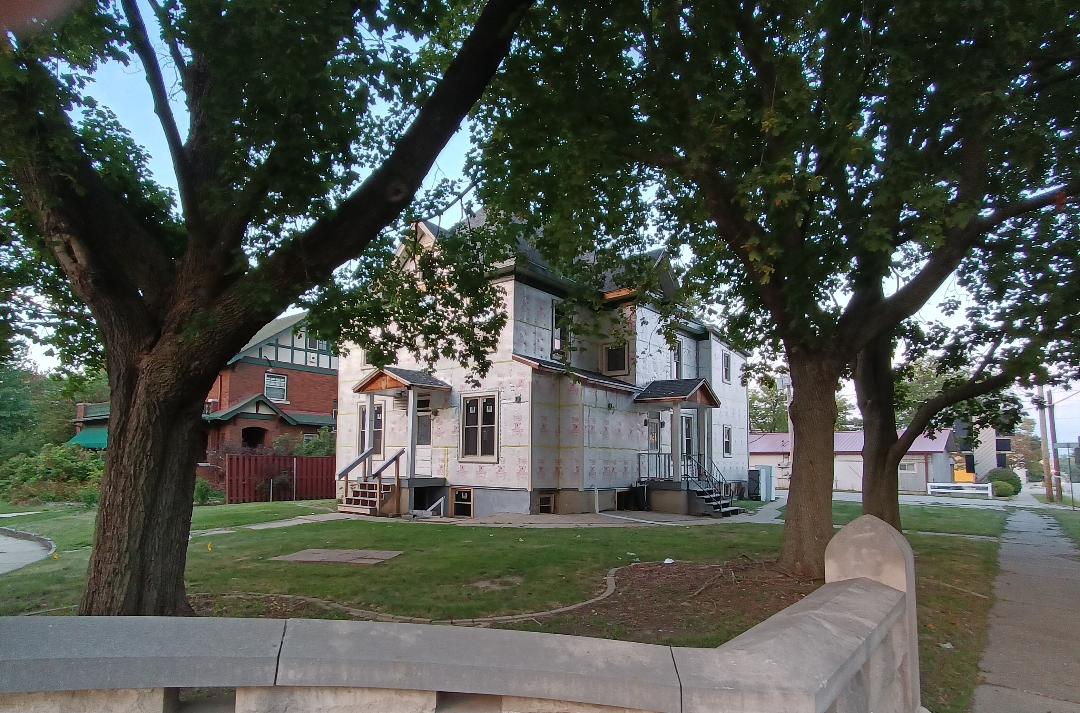
Renovations of a home at Number 1 White Place in Bloomington have neighbors feuding about public safety and “privilege.”
The once single family home was divided into nine apartments several years ago. Currently the entire property is being renovated so that it can again be utilized as nine housing units.
Neighbors believe the house sat vacant long enough that the improvements should have had to go before the city’s zoning board for approval. But the city says only approved permits were needed for the renovations to be made and the building to continue to be used for the apartments.
A number of residents on White Place spoke at the Bloomington Council meeting on Aug. 28 against the building being allowed to be renovated for nine apartments.
“The problem is that this house with so many units in it, it’s not a convenient place to live,” said Jonathan DeLashmit. “You can imagine the type of apartment that is jammed into a house where there is so many of them and that the cost and how filthy it gets, people don’t live there by choice. They live there because they have no other option for the price point. And then they basically fester inside.”
“The type of unsavoriness that even the tenants bring into this neighborhood, there’s prostitution, there’s guns, there’s drugs,” he said. “One time when my daughter and I were walking, one of the neighbors stopped us and talked to my daughter, not to me, and invited her in for a photo shoot. She was five.”
“I want to emphasize that this is not a case of Not in my Back Yard,” said Joe Gibson, who lives two houses north of Number 1 White Place.
Several people opposing the building reopening with nine apartments put forth a number of arguments supporting their beliefs. They included that there wasn’t adequate parking and that additional traffic would endanger children. The neighbors asked that the matter be referred to the zoning board, or be placed on a future council agenda.
Not everyone believed Gibson’s statement– that this was not a case of NIMBY.
Comments made by DeLashmit in particular may have played a role in motivating others to come out and speak in support of the renovations at number 1 White Place. Some appeared at this week’s council meeting.
“I don’t know if any of you took the time to listen to the comments last time, but it was absolutely painful,” said Jenae Clark, “Especially, Ward Four, I don’t know how you could sit there and hear your neighbors spew that kind of garbage and not be completely embarrassed. But the comments that I heard, they basically were just about entitlement and privilege.”
“I also heard people saying that there were people sitting outside,” said Clark. “People do that. But I guess these are the wrong people, right? But maybe they don’t have air conditioning. A lot of people don’t have air conditioning and they sit outside when it is nice out.”
“The only thing I see festering here in Bloomington -Normal is the rotten to the core NIMBYism,” said Clark.
“Frankly the concern seems more about the ‘unsavoriness’ (presence) of persons of lower income strata next to a particular residential strata,” said a person who identified himself as Chris.
“There are people in our community right now who need every one of those nine units,” said Matt Toczko. “They (residents of White Place) are basically trying to pick their own neighbors based on their own bigoted views of those less fortunate than them,” said Toczko. “One of their speakers said all of the quiet words out loud using language like unsavory, likening those less well off to drug dealers and prostitutes.”
Councilmember Jenna Kearns said, “I think those neighbors seemed very passionate about the issue and had their reasons that they came up and spoke and then communities in the ward but outside of White Place brought up some very interesting points as well. I think that there might be common ground. I think they may be talking past each other.”
Staff has gathered information regarding the matter and it has been transmitted to council, according to City Manager Tim Gleason. He will be scheduling three on one meetings to discuss the situation with council members.