


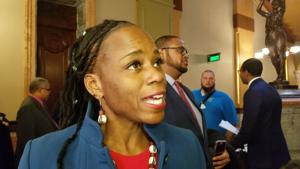
(The Center Square) – The federal indictment of Illinois state Rep. Carol Ammons and her husband, Champaign County Clerk Aaron Ammons, is raising broader questions about how campaign funds are monitored and whether current disclosure laws do enough to prevent abuse.
A federal grand jury indicted Carol Ammons on multiple counts, including wire fraud, making false statements to the FBI and conspiracy to obstruct justice.
Aaron Ammons faces charges of conspiracy to obstruct justice and obstruction of justice. Federal prosecutors allege Carol Ammons misused campaign funds and helped steer state grant money in ways that financially benefited members of her family. Both have denied the allegations.
According to the indictment, prosecutors allege campaign funds were used to pay family members for work that was never performed.
The indictment also alleges Carol Ammons used her position as a state lawmaker to help secure grant funding for nonprofit organizations that employed her daughter, allowing her daughter to receive salary payments tied to those grants.
In statements, Carol and Aaron Ammons has denied any wrongdoing.
Anna Massoglia, campaign finance expert and editor with MuckRock, said Illinois law is designed to prevent campaign funds from being used for anything other than legitimate campaign purposes.
“There are Illinois election laws that prohibit using campaign funds for work that wasn’t completed or services that were not rendered,” Massoglia said. “The allegations here indicate that campaign money was used to pay Ammons and her family members for expenses that were not legitimate campaign costs and for work that was not actually performed.”
Massoglia said the allegations involving state grant funding expose a gray area in ethics oversight.
“There are a few safeguards in place that guard against a lawmaker steering grants to an entity that could support them in some way,” she said. “But there really isn’t a wall between a lawmaker’s grant-steering power and that same lawmaker’s family potentially benefiting a few steps removed from the grantee’s hiring decisions.”
While laws prohibit bribery and illegal kickbacks, she said indirect financial benefits are often much more difficult to detect and prosecute.
“It’s very hard to identify and enforce in some circumstances,” Massoglia said.
Rather than banning grants to nonprofit organizations, Massoglia said public officials should avoid participating in decisions where they or their families could financially benefit.
“There’s a real issue with allowing lawmakers to police themselves and decide where to draw that line,” she said.
Massoglia said cases involving alleged misuse of campaign funds are not uncommon.
“This is certainly not the only time a lawmaker has been accused of misusing campaign funds in a way that benefits family members or benefits themselves,” she said. “That happens at both the state and federal level, but that doesn’t make it any less problematic.”
She said one of the biggest challenges facing investigators is that campaign finance reporting relies heavily on candidates accurately disclosing their own spending.
“Campaigns are tasked with their own disclosure,” Massoglia said. “In some circumstances, you can see money going out, but the lack of disclosure in other circumstances makes it much harder to identify and even harder to prove.”
Current disclosure reports often show where campaign money was initially sent, but not necessarily who ultimately received the benefit.
“Disbursements may only show money going to a certain entity,” she said. “They wouldn’t necessarily show that entity paying other individuals who could be tied to a lawmaker.”
Massoglia said the case demonstrates why transparency remains one of the strongest safeguards available.
“It’s important for journalists, members of the public and those tasked with oversight to actually dig into these filings,” she said. “It’s important for this information to be disclosed so voters can understand who ultimately benefits from campaign and government funds.”
The indictment also includes obstruction of justice charges. Aaron Ammons is accused of participating in efforts to conceal records during the federal investigation.
“It is not uncommon for charges involving obstruction of justice, false statements or lying to investigators to accompany allegations involving campaign funds,” she said. “Sometimes those charges can be easier to prove than the underlying financial misconduct because they involve more tangible evidence.”