

(The Center Square) – Chicago Public Schools narrowly passed its budget for the coming school year, despite relying on money from unrealized and unallocated tax dollars from the city and state.
The CPS budget for the 2027 fiscal year is $9.96 billion, relying on mostly local and state funds. The district expected a $732.5 million deficit for the coming year, as spending continues to exceed revenue.
The largest deficit-covering funds are an assumption that local taxpayers will foot an additional $285 million in the form of surplus Tax Increment Financing districts – meaning there isn’t a guarantee the district will see the funds.
CPS Superintendent and CEO Macquline King said the district is in worse condition than last year.
“For the second year in the role, CPS has had to face down a significant budget deficit going into next school year,” King said. “Our cash flow is in a much worse position than last year. And with in-school staff reporting to work in less than three weeks, we need access to short-term financing in order to make payroll.”
Without a budget passed, the district couldn’t secure a short-term loan that leaders said will make it possible to pay teachers in September.
After an amendment, the budget no longer relied on nearly 2,000 teacher and staff layoffs as part of the plan. Instead, members added $150 million in unrealized state money, based on a verbal promise from some state lawmakers.
Fiscal staff said a reliance on assumed state funding could risk borrowing potential for the district in the coming weeks because the amendment may make it harder to argue the budget is balanced.
“In our opinion, an amended budget that included new state revenues could not be considered balanced,” said acting Chief Budget Officer for CPS Emilia Zoko.
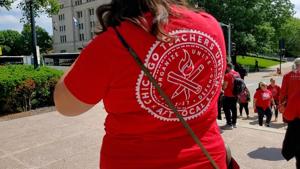
Stacy Davis Gates, president of the Chicago Teachers Union, asked the board before the vote to roll more assumed funding from other sources into the budget to prevent teacher layoffs and expand funding for schools.
“The way that you’re going to assume it for the mayor of Chicago. He signed up and he said, ‘yes,’ to the tune of a billion dollars. Who else can you assume as partners in this? Can you assume Maria Pappas? Can you assume Tony Preckwinkle? Can you assume J.B. Pritzker? Because we have people who assume it every day,” Gates said.
The union repeatedly called on lawmakers to return for a special session to pass supplemental funding – a request made during the spring session, but not addressed before it ended.
House Speaker Emanuel “Chris” Welch, D-Hillside, told the CTU on Wednesday he doesn’t plan to call a special session, but said he would back a bill for funding later this year.
“I’m strongly committed in the veto session to supporting the supplemental funding bill because I know we’re all going to be there for the veto session,” Welch said. “I will lead that effort in the veto session. We got two weeks in November that we can get it done.”
Rep. John Cabello, R-Machesney Park, told The Center Square that supplemental funding shouldn’t be exclusive to Chicago schools.
“Unfortunately there’s been many people that are not school teachers that are making those types of decisions on how money is being spent. The school boards have screwed this stuff up so badly,” Cabello said.
Cabello noted he thinks Welch is looking to change the narrative around his leadership amid “turmoil” about his handling of sexual harassment complaints.
The board passed the budget by a vote of 11-7.
If the district doesn’t get the additional assumed funds to cover the gap by the middle of the school year, the board will return to the budget mid-year to adjust allocations, likely through major personnel cuts for the remainder of the year.