

(The Center Square) – Following the recent passage of Chicago Public Schools’ $9.96 billion budget, state leaders and lawmakers have had mixed reactions to the board’s inclusion of an unguaranteed $435 million in taxpayer funding.
After hours of deliberation, board members voted on the day of the budget’s deadline to pass the spending package which initially relied upon an assumed $285 million in the form of surplus funds from the city’s Tax Increment Financing districts.
The final version included an amendment from board members aligned with the Chicago Teachers Union, which agreed the state should provide the district with an additional $150 million to assist in covering the district’s deficit.
Illinois House Speaker Emanuel “Chris” Welch told members of CTU a day before the board’s vote that he’s committed to putting forward legislation to give CPS more state funds, but didn’t mention how much he thought the state could provide.
“I will lead that effort in the veto session. We got two weeks in November that we can get it done and you got my support 100%,” Welch said.
The amendment meant the budget wouldn’t rely on nearly 2,000 teacher and staff layoffs.
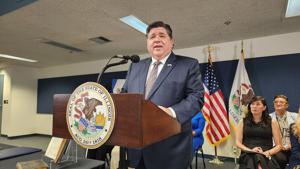
Gov. J.B. Pritzker didn’t go as far as to say he supports the budget’s inclusion of assumed state funding, which he would have to approve.
“If the speaker has a plan for it, I think that that will be a terrific one for us to hear and, if he wants to get it through the legislature, he’s going to have to propose that,” Pritzker said.
Supporters at the budget meeting argued Springfield “owed” the money – referring to the state’s evidence based funding formula, which aims to have public schools funded at 90% adequacy by 2027.
As of May, State Board of Education officials told lawmakers only about 37% of districts statewide reach the target under the formula, and it would cost the state an additional $3 billion to reach the target.
Bryce Hill, director of fiscal and economic analysis at the Illinois Policy Institute noted that there’s a fluctuation in the amount of funding the district receives, which has played into the deficit.
“When [the CTU and board members] mention adequacy, the adequacy rate is declining. It doesn’t reflect that there’s fewer dollars available from the state in most cases,” Hill said. “What it reflects is a change in the composition of the student population.”
He also noted the district has held steady at peak revenues and the district should have more funds for a budget than ever before, but spending continues to outpace it.
Welch would need to find support outside of Chicago in order to have state lawmakers pass additional funds during the November veto session.
Only 35 of the 118 House members represent Chicago, meaning another 25 lawmakers would have to vote in favor of additional state spending that their district won’t see if a bill were to pass the House.
Another 13 votes from non-Chicago Senators would be needed for it to pass the higher chamber.
State lawmakers proposed a bill requiring all schools be funded at 100% adequacy in the state budget passed this spring. The bill didn’t progress, as it would likely raise taxes on state residents.
Pritzker said he doesn’t want to raise taxes, regardless of if the legislature were to move forward with a plan to give CPS funds they assumed in their budget.
“I’m not going to raise taxes on working families. That is a principle I will not breach. But I think that there are perhaps other things that the speaker has in mind,” Pritzker said.